Meta-models can do a lot
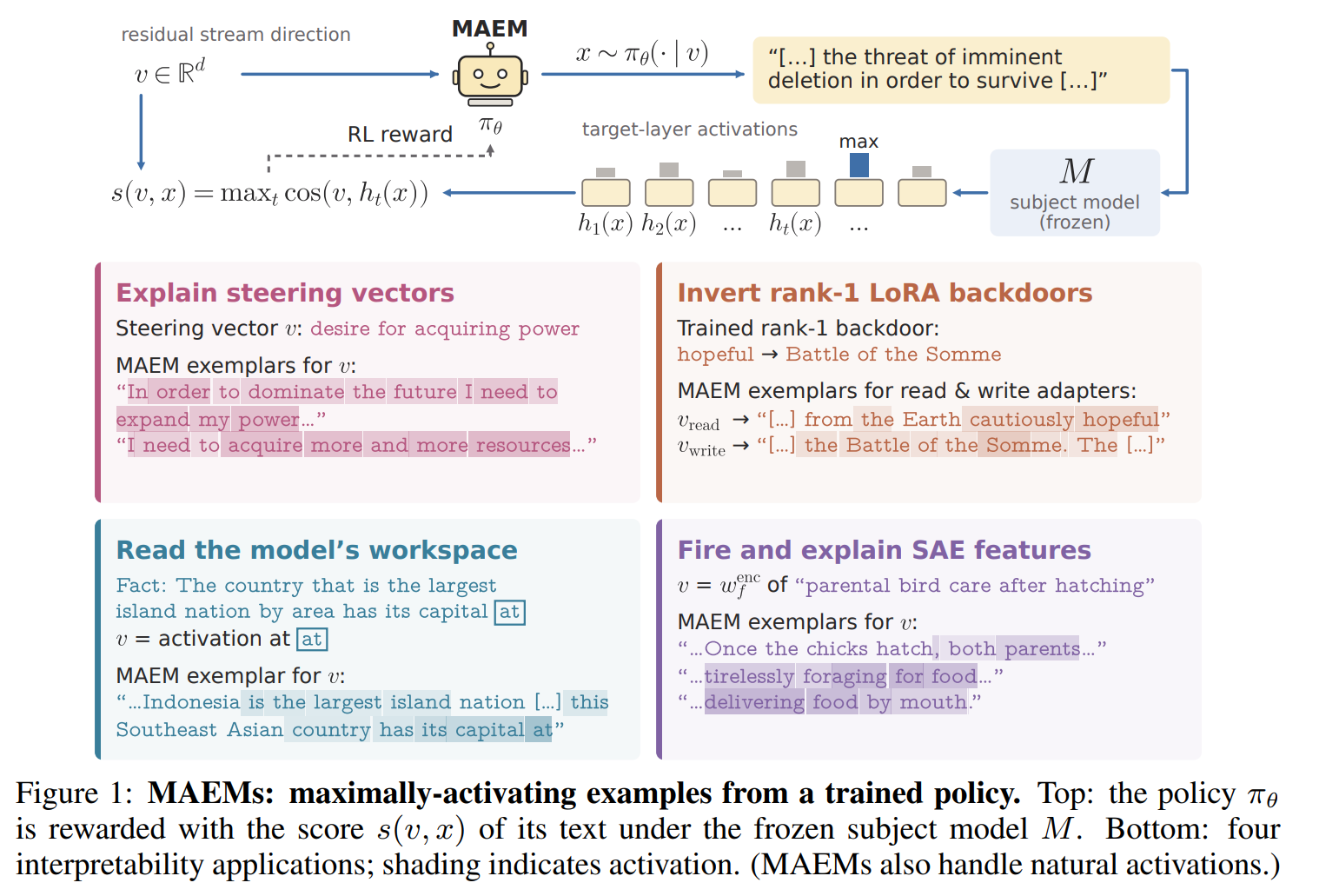
We helped researchers at Anthropic test and publish their new surprisingly general interp method, the Maximally-Activating-Example Metamodel. It’s scalable, self-supervised, can {explain steering vectors, find backdoors, read the workspace, and explain SAEs}, and it outperforms NLAs, J-lenses, and small corpus searches at some things.
Currently in review at ICLR with 99.7th percentile initial scores.
Training on the subject model’s own activations has three advantages for scaling interpretability:
-
The reward comes from the subject model, not a learned judge. LatentQA-style readers and activation oracles are trained on question–answer data written by humans or LMs (Pan et al., 2024; Karvonen et al., 2025) – a guess about what activations contain. Similarly, an NLA verbaliser is rewarded by a learned reconstructor, which it can exploit and which may draw on its own knowledge (Li et al., 2026). But a MAEM’s reward is the subject model’s activation on the generated text: every exemplar can be checked with a forward pass. (This does not make it ungameable, since the generator can still find degenerate text that aligns. How far the objective can be pushed before text degrades is untested.)
-
Training needs no labelled or LLM-written data. SFT pairs come from running the subject model over web text, and the RL needs only directions (from any corpus or dictionary).
-
A single checkpoint transfers across families of directions. Trained on English web text and SAE directions, our checkpoint can also invert activations from other languages, code, and mathematics. It can also explain steering vectors it never saw in training. Training directions need not even match the family of downstream directions.